Emotional support animal laws by state: the 2026 map
Since May 22, 2026, the single most important fact about your ESA rights is which state you live in. HUD's enforcement change narrowed the federal backstop for untrained ESAs, but it explicitly left every state and local law untouched. So the country now splits three ways: states whose own laws protect support animals regardless of the federal shift, states that relied on the federal framework and feel the change fully, and states that regulate ESA documentation itself.
Every state page is researched against primary sources — statutes and state agencies, not other ESA websites — and shows its last-reviewed date.
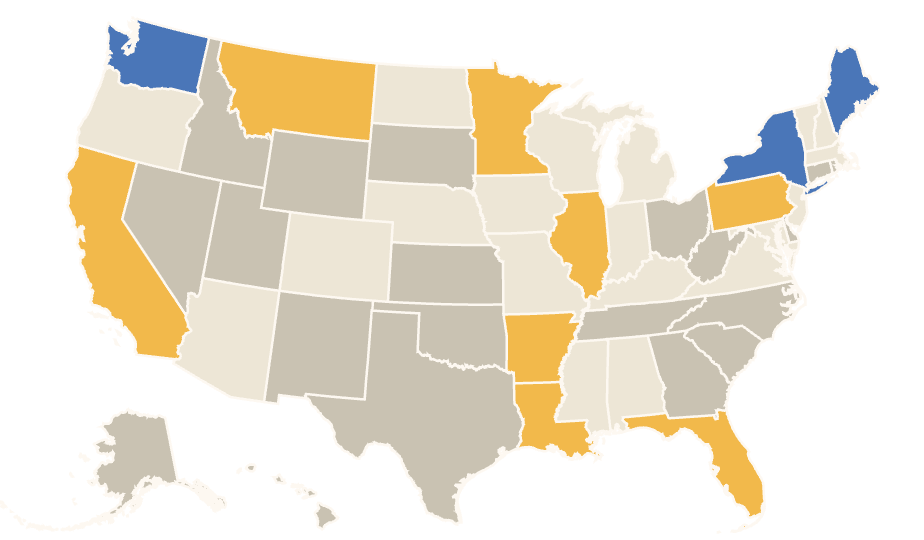
Three kinds of state in 2026
Independent protection
The state's own fair-housing law covers support animals without a training requirement, enforced by a state agency applying state law. HUD's memo changed little here. Clearest examples: California (FEHA), New York (Human Rights Law), Florida (§760.27).
Federal framework
No state ESA housing statute — protection ran through the federal FHA and HUD's now-narrowed enforcement. The 2026 change bites hardest here; your remaining tools are a properly made written request, negotiation, and the preserved private right of action. Clearest example: Texas.
Documentation-regulated
The state sets rules for the letter itself — minimum relationship periods, in-state licensure, required disclosures — often with penalties for fakes. These states typically also protect ESAs; the regulation targets fraudulent letters, not legitimate ones. Verified: CA, AR, IA, LA, MT (30-day) and FL ("personal knowledge" + §817.265).
Groups overlap — California is both independently protective and strictly regulated. Each state page spells out its own combination.
The map
Click any state to jump to its row in the table belowOne glance at how the country splits. Click your state to jump to its detail row. States awaiting primary-source verification render neutral — we never guess a state into a group.
All 51 jurisdictions, in detail
⚠ verifying marks rows researched from secondary legal sources, awaiting primary-source verification by counsel — deliberate rigor, not an unfinished page. We cite what's reported and won't state it as settled until confirmed. Every state's full page carries its own verification status and last-reviewed date.
What to check, in order
Does your state have its own law?
If yes (blue or yellow), your position likely changed little in 2026 — your requests and complaints run through state statute and a state agency.
Does your state regulate the letter?
If yes (yellow), compliance is non-negotiable: a letter that skips a 30-day rule or an in-state-licensure requirement can be lawfully rejected — and in some states, worse.
If neither: the federal framework
The FHA still exists, private claims survive, and well-documented requests still succeed with most landlords — but plan for more friction than before May 2026. Denied? Start here →
Common questions
Current as of August 24, 2026.
Which states still fully protect emotional support animals in 2026?
States whose own fair-housing laws cover support animals independently of federal enforcement. California, New York and Florida are verified examples, and we're completing primary-source review of the rest. See the table for current status.
Did any state's law change because of HUD's 2026 memo?
No. The memo changed HUD's internal enforcement standard and explicitly left state and local law untouched. What changed is how much weight the federal layer carries, which makes the state layer decisive.
Which states have a 30-day rule for ESA letters?
Verified: California, Arkansas, Iowa, Louisiana and Montana require an established client relationship before a letter can issue. Florida uses a different mechanism: the practitioner must have “personal knowledge” of your need.
I'm moving to another state. Does my ESA letter transfer?
The clinical content doesn't expire at the border, but practical validity can: several states expect the letter to come from a professional licensed in that state, and regulated states impose their own mechanics. Check the destination state's page before you rely on an old letter.
What does the “verifying” flag mean?
It marks statutory citations researched from secondary legal sources and awaiting primary-source verification by counsel. Deliberate rigor, not an unfinished page: most ESA sites copy each other, which is how wrong claims spread for years. We cite what's reported and won't state it as settled until confirmed.
Wherever you are, start with what's true there
A letter that works is one written by a clinician licensed in your state, following your state's rules. That's the only kind we do.